
¡Aprenda a vivir de la tierra en el mitin por la Libertad y la Prosperidad!
6 de abril de 2024 | St. Cloud, Florida | 9 a. m. - 5:30 p. m. EST
Tendremos personal reducido durante las fiestas. Si tiene dificultades para comunicarse con nosotros por teléfono, por favor deje un mensaje de voz detallado y le devolveremos la llamada a la brevedad. Alternativamente, puede contactarnos por correo electrónico a questions@freedomlawschool.org.
.png)
Many states tie their income tax laws to federal income tax laws by adopting Internal Revenue Code definitions, calculating state tax as a percentage of federal taxes owed, or using other methods. This practice, referred to as “piggy-backing” by Freedom Law School, means most residents in these states may not owe additional state income taxes. Please refer to the map and information below or go to the Interactive State Income Tax Map.
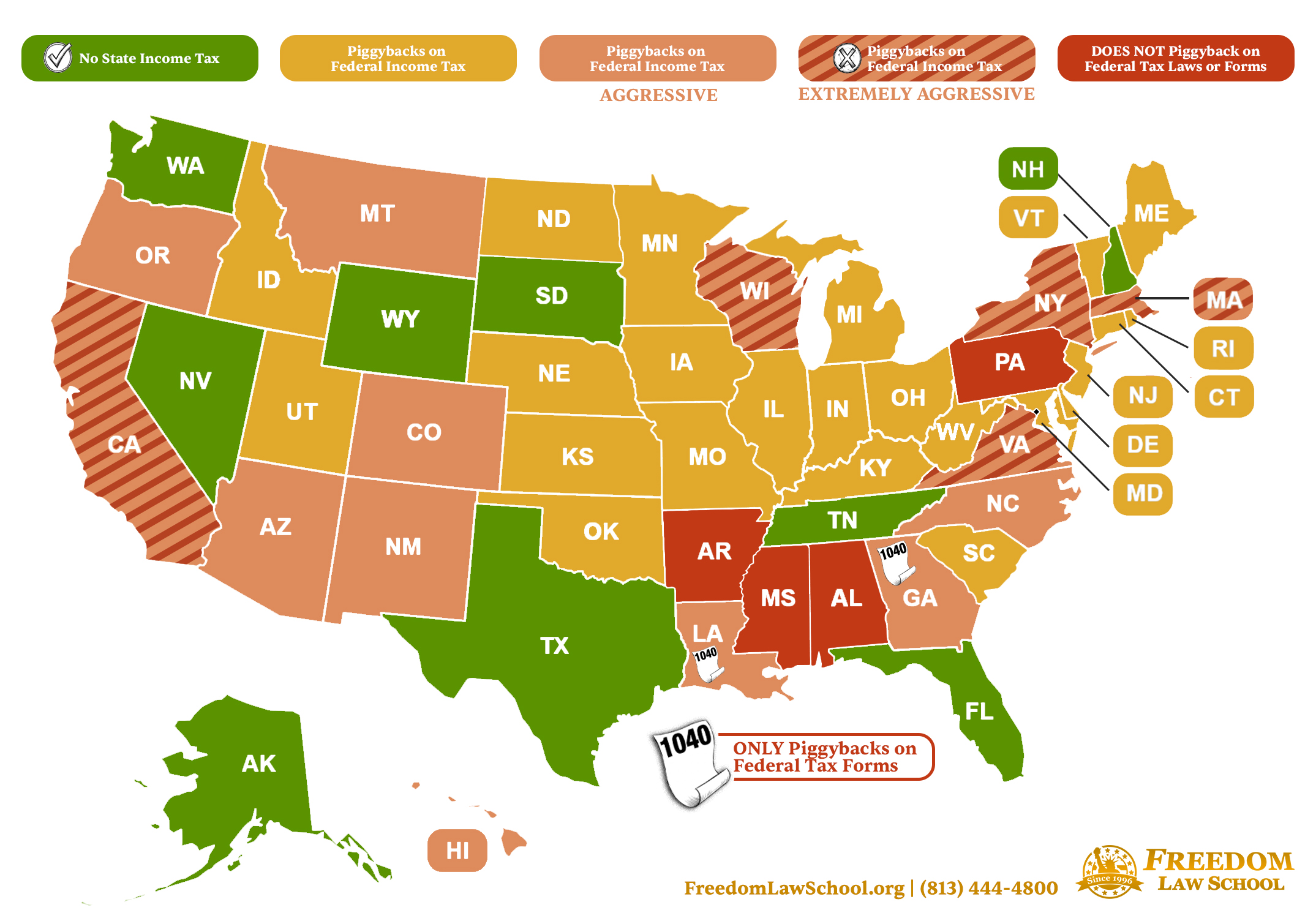
While our Restore Freedom Plan and Employer Freedom Plan do not cover state tax collections, our staff is available to assist students in responding to unwarranted collection attempts by state taxation agencies.
You don’t need to do anything! These states don’t have any income tax.
These states’ have an income tax which laws are based on the federal income tax laws.
State tax agency is known to be aggressive with collections +
State tax agency is known to be very aggressive with collections ++
These states’ income tax laws are independent from federal laws, and you cannot exempt from them.
If you have additional questions or concerns, call our office and ask directly by calling (813) 444-4800.
In tax laws and other federal laws, the term United States can have different meanings depending on the specific legal section. A common assumption is that the term includes all 50 States, but this isn't always the case. To understand the correct application of a law, you must refer to the definitions provided within that specific law or chapter, as they can change.
Because the term United States has different definitions depending on the law, it is argued that for tax purposes the 1040 US Individual Income Tax Return applies only to those who are a citizen or resident of the District of Columbia. Therefore, the people in the 50 States are not legally required to file this form or pay income tax.
There are Mortgage Brokers who do not need to see tax returns, and there are absolutely ones that are 100% legit! For example, see this very helpful explanation, “No Tax Returns? No Problem”, by Scott Smith of New Destiny Mortgage.
Many of our FLS members have been successful in becoming home owners without providing tax returns.
Unfortunately, due to regulations, you MUST submit your current address (which can be a PO box or private mailbox) to the IRS. The purpose of keeping your address current is to enable you to legally combat actions the IRS may take against you. If you do not, the IRS can claim, for example, that they sent you collections documents yet you never responded refuting their collections efforts.
When you stop filing tax returns, the IRS may send a series of letters. It is important to understand what these letters mean and how you should respond.
You have legal protections against the IRS, with the most significant being the right to a trial. By requesting a Collection Due Process hearing and, if necessary, petitioning the Tax Court, you can legally challenge the IRS. The IRS is prohibited from taking any of your property while your case is in Tax Court.
Overview:Do you want to be able to pay zero estate taxes—no matter how huge your estate may be, even into the billions of dollars—legally and safely?
When dealing with a large inheritance, accountants, CPAs, and tax attorneys will inevitably point to the IRS's minimum filing thresholds (roughly $14 million in 2025 and $15 million in 2026) and advise you to file and pay federal estate taxes. They blindly follow the IRS's assumptions, often costing grieving families millions of dollars.
However, a strict reading of the Internal Revenue Code (Title 26) and U.S. Supreme Court precedent reveals a shocking truth: the federal estate tax, as defined by positive law, does not legally apply to the people of the 50 sovereign states.
For over 30 years, Freedom Law School founder Peymon Mottahedeh has successfully educated Americans on how to legally free themselves from deceptive federal taxation. Here is the step-by-step statutory proof showing why you do not owe the federal estate tax.
To understand who actually owes the estate tax, you must look at the exact wording of the law. The Internal Revenue Code (Title 26) is the "Bible" of the IRS, and the government publishes this code on its official legal website at uscode.house.gov.
Under 26 U.S.C. § 2001 (Imposition and Rate of Tax), the law clearly states exactly who is subject to the tax:
"A tax is hereby imposed on the transfer of the taxable estate of every decedent who is a citizen or resident of the United States."
This exact phrasing is mirrored on IRS Form 706 (the United States Estate Tax Return). Right below the main headline, the form clearly states that it is for the "Estate of a citizen or resident of the United States."
Naturally, most people assume that being a citizen of Florida, Texas, or California makes them a "citizen or resident of the United States." But in federal tax law, words have highly specific, restricted definitions.
To find out what the "United States" actually means for the estate tax, we must look at the definitions section of the Internal Revenue Code. Congress deliberately hides these definitions at the very end of the massive 10,000-page tax code, knowing that few CPAs or tax attorneys will ever bother to look them up.
Under 26 U.S.C. § 7701 (Definitions), Congress explicitly defines the geographic boundaries of their tax laws:
If you substitute the legal definition of "State" back into the definition of "United States," it reads: The term 'United States' includes only the District of Columbia and the District of Columbia.
Noticeably absent from these definitions are the 50 sovereign states. The term "United States" in the Internal Revenue Code legally refers only to the District of Columbia. Therefore, the federal estate tax imposed in § 2001 strictly applies to a citizen or resident of Washington, D.C.
Can the IRS simply ignore these definitions and assume the 50 states are included anyway? According to the U.S. Supreme Court, absolutely not.
In the 2000 Supreme Court case Stenberg v. Carhart, the Court established a strict and mandatory rule for how laws must be read:
"When a statute includes an explicit definition, we must follow that definition, even if it varies from that term's ordinary meaning."
The Court went on to explain that it is "axiomatic" (self-evident and undeniable) that a statutory definition excludes any unstated meanings. Because the 50 sovereign states were deliberately left unstated and excluded from the legal definition of the "United States" in Section 7701, the IRS has no legal authority to apply the estate tax to them. The ordinary, everyday meaning of the word is thrown out the window.
Another common tactic used by the IRS and misinformed accountants is to claim that the 50 states are "implied" to be included in the tax code. The U.S. Supreme Court completely struck down this argument in the unanimous 1917 decision Gould v. Gould:
"In the interpretation of statutes levying taxes, it is the established rule not to extend their provisions, by implication, beyond the clear import of the language used, or to enlarge their operations so as to embrace matters not specifically pointed out. In case of doubt, they are construed most strongly against the government, and in favor of the citizen."
The federal government cannot legally tax your estate by implication. Because the 50 sovereign states are not "specifically pointed out" in the legal definition of the "United States" for estate tax purposes, the law must be construed strictly against the government and in favor of the citizen.
Skeptics may still wonder if the exclusion of the 50 states was just a typo or a mistake. However, we have proof that Congress knows exactly how to include the 50 states when it wants to.
For example, look at the federal excise tax on petroleum under 26 U.S.C. § 4612. In this specific section, Congress explicitly broadens the definition of the United States to capture a wider tax base:
"...the term 'United States' means the 50 States, the District of Columbia, the Commonwealth of Puerto Rico... continental shelf areas, and foreign trade zones."
When Congress wants to legally tax the 50 states, they explicitly write "the 50 States" into the law. They deliberately left the 50 states out of the definitions for estate and income taxes. You cannot assume anything when it comes to federal tax laws.
The federal estate tax is legally a District of Columbia tax. Unless the decedent was a citizen or resident of Washington, D.C., their estate legally owes zero federal estate taxes, regardless of its size.
For decades, CPAs and attorneys have operated on fear and assumption, advising their clients to blindly pay millions—or even billions—of dollars to the IRS that they never legally owed. You do not have to volunteer your family's hard-earned legacy to the D.C. swamp.
A common misconception is that receiving a W-2 or 1099 form from an employer or third party automatically triggers a legal obligation to file a 1040 income tax form. Many believe that filing is the safest way to avoid IRS audits and prison. In reality, voluntarily signing and submitting a 1040 form increases your legal risks and traps you in a system you are not legally required to participate in.
When you sign a 1040 income tax form, you are signing it under penalties of perjury, swearing under oath that the information is true, correct, and complete.
The IRS relies on fear and propaganda because it lacks the manpower to enforce compliance across the board.
The Internal Revenue Code (Title 26) relies on highly specific legal definitions that differ entirely from ordinary English. Employers are deceived into sending W-2s and 1099s because they misunderstand these statutory terms.
If you received a W-2 or 1099, the ultimate goal is to correct the paperwork at the source so employers stop withholding your property and reporting it to the IRS.
When considering how to handle the IRS, it is vital to weigh the actual legal risks and benefits of submitting tax documents. For over 30 years, our Founder and President, Peymon Mottahedeh, has openly refused to file or pay federal income taxes and has successfully taught others how to legally and safely do the same.
Below is a breakdown of the realities behind the 1040 form so you can make an informed decision for your 2025 records.
The IRS operates using military principles found in Sun Tzu's The Art of War, specifically the tactic of subduing an enemy by making them believe they are weak while the enemy is strong. By convincing Americans to voluntarily sign the 1040 income tax confession form, the IRS wins without risking resources. The vast majority of the IRS's revenue is not generated from enforcement or audits, but rather from taxpayers voluntarily filing returns and confessing that they owe money.
Signing and submitting a 1040 form places you in immediate legal jeopardy.
Filing a 1040 form means you waive your 5th Amendment right to remain silent and voluntarily hand over all your private financial information for the government to use against you.
By signing the form under penalties of perjury, you are swearing under oath that everything is 100% true, correct, and complete.
You formally confess under oath that you have taxable income and owe the IRS the specified amount of money.
Filing puts the burden of proof entirely on your shoulders to justify all business expenses, deductions, and credits.
Submitting the form gives the IRS legal permission to audit you.
If you are audited or charged, you are forced to spend massive amounts of money hiring CPAs and tax attorneys for your defense.
For each 1040 form you file, you risk being charged with three separate tax crimes: attempting to evade a tax (5 years), filing fraudulent statements (3 years), and filing fraudulent returns (1 year), carrying a combined risk of up to nine years in prison.
IRS data books reveal that over 93% of the individuals the IRS sentences to prison are those who actually filed tax returns, whereas non-filers make up a tiny fraction of convictions.
Former IRS Criminal Investigation Division special agent Joe Banister confirmed that the IRS's standard procedure is to request a person's previously filed tax returns to use the information on those documents against them.
The legal defense for a filed return is so incredibly difficult that former U.S. Tax Court Judge Diane Kroupa chose to plead guilty and accept a 34-month prison sentence rather than attempt to defend the 1040 form she had submitted.
The money you surrender through this process is used to fund forever wars, protect pedophiles, and sustain federal government corruption.
For individuals holding digital assets, the 1040 form represents a specific and dangerous trap.
The 1040 form includes a direct question asking if you sold, exchanged, or liquidated any digital assets.
Answering "yes" automatically flags you for an aggressive IRS audit because the agency assumes all crypto transfers—even movements between your own private wallets—represent taxable gains.
Answering "no" when you have engaged in crypto transactions constitutes lying under oath, which exposes you to severe tax evasion and perjury charges.
The only notable benefit to filing a 1040 form is that you may potentially secure a slightly lower interest rate when borrowing money for a business loan or a real estate purchase.
Stepping out of the voluntary tax system eliminates the legal traps designed to ensnare filers.
There are virtually no risks to not filing, as the IRS actively leaves over 99.9% of non-filers completely alone.
When you do not file, you do not sign an oath confessing you owe money, meaning the IRS is forced to follow strict due process.
To pursue a non-filer, the IRS must create a formal tax proposal and issue a Notice of Deficiency, which grants you the right to challenge their claims in U.S. Tax Court with a full trial—a process that can tie them up for years.
Students who utilize the Restore Freedom Plan receive a firm guarantee: if you follow the law and the prescribed steps, you will stay out of prison, and if the IRS ever forcefully takes your money, we will reimburse you in full.
Instead of funding government corruption, your wealth remains with you to support freedom movements and the restoration of a free republic.
If you are a green card holder, you still do not have to file and pay income tax, unless you are a resident of Washington D.C. or you are performing work functions of the federal government.
No, you must have a drivers license, license plate, registration, etc. Roads are government built, maintained and funded roads.
Do not buy into patriot mythology. We love promoting freedoms, but some theories, even when they sound well-put, are simply wrong.
These are also protected under our guarantee same as any other income/investments. For those who are “mining” cryptocurrencies, make sure to include any amounts that you “mine” under the “self employed” section of our application. For any buying or selling of cryptocurrencies, make sure to include it in the appropriate section of the “capital gains” portion of our application to make sure it is covered by our guarantee. For any appreciation on its value, make sure to include that in the “interest and dividends” portion of the application.
Fear not! For many years Peymon has been accumulating his wisdom and strategies, documenting them, and passing them along to passionate activists who will one day be able to carry on Freedom Law School. You will not be stuck when Peymon passes away.
Richard Grant, once a student at Freedom Law School, ceased filing and paying income tax prior to his enrollment as a member. Subsequently, the IRS pressed criminal charges against Richard. However, he opted to engage a lawyer against FLS’ recommendations. Unfortunately, this decision left Richard inadequately prepared for his defense and lacking comprehension of IRS protocols, ultimately resulting in his prison sentence.
Several mainstream media outlets, including Forbes, have inaccurately and unjustly linked Richard’s imprisonment to Freedom Law School in an attempt to discredit FLS.
Filing 1099 forms is not required for most Americans, and is simply a way that the IRS can collect information that they do not need to collect on taxes they are not owed.
Revocation of election to stop paying federal income tax is a patriot mythology. The process of revocation of election involves sending a letter to the IRS to revoke your election to pay income taxes for the rest of your life.
Freedom Law School does not deal with revocation of election, because it is not a successful legal strategy in practice.
In the income tax freedom movement, some alluring teachers use the term ‘[American] State National’ (aka “sovereign citizen”) to describe a fictitious citizenship status, aiming to liberate themselves from the constraints of U.S. law.
Sovereign citizens believe that the existing American governmental structure, including the courts and law enforcement, is illegitimate and that they retain an individual common law identity exempting them from the authority of those fraudulent government institutions. They may issue their own driver’s licenses and vehicle tags, create and file their own liens against government officials who cross them, question judges about the validity of their oaths, challenge the applicability of traffic laws to them, and in extreme cases, resort to violence to protect their imagined rights.
Sovereign citizens speak an odd quasi-legal language and believe that by not capitalizing names and by writing in red and using certain catchphrases, they can avoid any liability in the judicial system.
Read this excerpt from a State National promoter’s page:
As a completely unincorporated Person, a State National is sovereign and private and generally immune from prosecution until and unless they take some action that causes actual physical harm to someone else or someone else’s property, whereupon they are subject to the Common Law of the County and State where they live or where the alleged crime is committed. (Source)
You read that right, American state nationals and sovereign citizens claim that they are immune from prosecution unless they cause physical harm to person or property. Does this work? No.
Sovereign citizens’ tactics often succeed in delaying legal proceedings, and may occasionally confuse or exhaust public officials. However, their arguments are never upheld in court. (Source and Reference)
Can I claim sovereign citizenship? Does using a ZIP code make me part of DC? Does my name in CAPITAL LETTERS refer to my straw man? Am I out of the federal government’s jurisdiction?
These theories are what Freedom Law School refers to as “baseless legal theories” or “patriot mythologies.” With the ease of internet communications, these baseless theories spread like weeds, offering fantasy solutions to common Freedom and Tax Honesty Movement issues. They sound great, but in reality do not work. Unfortunately, in dealing with the corrupt IRS and U.S. government, there are no “silver bullet” miracle cures.
Ultimately, the focus is not solely on the technical accuracy of a theory, but rather on its practical effectiveness and likelihood of being upheld in court. The sovereign citizenship theory, like many others, does not work in practice. Rather than dabbling in a multitude of unfounded theories, stick with what has been proven effective. Check out Freedom Law School’s seven steps and our track record of court victories.
Irwin Schiff was a very honorable patriot to be commended for his work in the Tax-Honesty and Freedom Movements. Irwin however made mistakes and refused to accept advice from Peymon and others. While Irwin was technically 100% correct on the fact that there is no law requiring the average American to file and pay income taxes, he did not follow procedure to protect himself better from the corrupt court systems.
Wesley Snipes relied on something we warn you about at Freedom Law School: fake patriot mythology. Wesley Snipes did not get a prison sentence from following Freedom Law School’s advice. He relied on the false advice of Eddie Kahn and mailed in a fake, phony, fraudulent receipt to the IRS for taxes he owed, expecting a refund.
Zero returns are an attempt to get money back from the IRS after filing. The process involves filing a tax return with the IRS which shows zero income.
This method is advocated by Pete Hendrickson, notably in his book “Cracking The Code” and on his website, Lost Horizons. Both Pete Hendrickson and his wife, Doreen, were sentenced to prison after using this method. (Source.)
They may work to get money back from the IRS, but are not recommended by Freedom Law School because it defeats the purpose of not filing, and involves lying on a return which exponentially increases your chances of being pursued by the IRS.
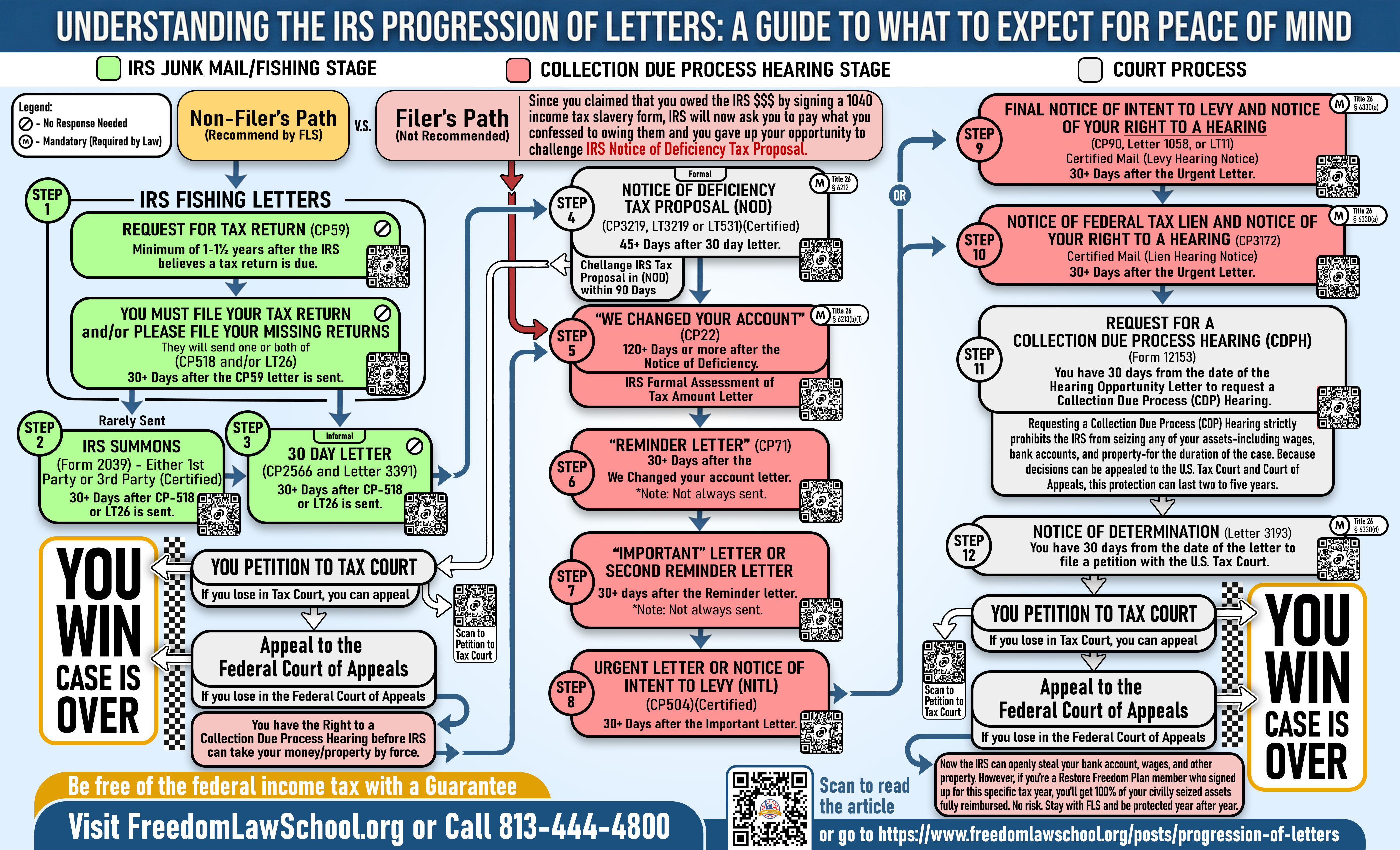
When you stop filing tax returns, the IRS may send a series of letters. It is important to understand what these letters mean and how you should respond.
You have legal protections against the IRS, with the most significant being the right to a trial. By requesting a Collection Due Process hearing and, if necessary, petitioning the Tax Court, you can legally challenge the IRS. The IRS is prohibited from taking any of your property while your case is in Tax Court.